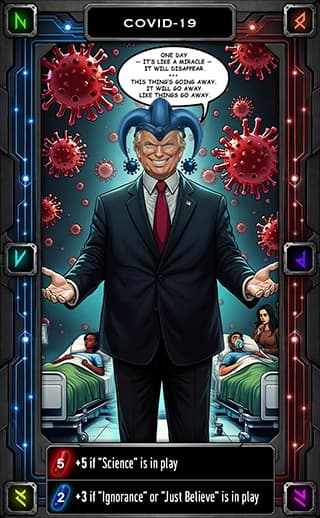
President Trump reorganized the National Security Council’s pandemic preparedness office in 2018 and repeatedly stated in 2020 that COVID-19 would “disappear,” as the virus spread across the United States.
Full text
Description:
President Trump reorganized the National Security Council’s pandemic preparedness office in 2018 and repeatedly stated in 2020 that COVID-19 would “disappear,” as the virus spread across the United States.
�� Summary
In 2018, the National Security Council (NSC) Directorate for Global Health Security and Biodefense — a unit created after the Ebola outbreak — was dissolved during a broader restructuring under National Security Advisor John Bolton.[1] Staff were reassigned rather than terminated, but the dedicated pandemic-focused directorate was eliminated as a standalone entity.[2] In early 2020, as COVID-19 cases rose globally, President Trump publicly stated, “It’s going to disappear. One day — it’s like a miracle — it will disappear.” (Feb. 27, 2020).[3] On August 5, 2020, he said on Fox & Friends, “This thing is going away, it will go away like things go away.”[4] By January 20, 2021, approximately 400,000 Americans had died from COVID-19.[5] Total U.S. confirmed/reporting-based deaths later surpassed 1.2 million.[6] Fact-checkers and retrospective reviews documented repeated instances in which the virus was described as diminishing or under control while national case counts were rising.[7]
�� Findings
1️⃣ Core Event / Primary Evidence
On February 27, 2020, President Trump stated:
“It’s going to disappear. One day — it’s like a miracle — it will disappear.” (Feb. 27, 2020).[3]
The statement appears in the official White House archived transcript of his meeting with African American leaders.
On August 5, 2020, during an interview on Fox & Friends, he said:
“This thing is going away, it will go away like things go away.” (Aug. 5, 2020).[4]
Both quotes are documented in official transcripts and independent fact-checking archives.
2️⃣ Supporting Evidence / Context
In 2018, during an NSC restructuring, the Directorate for Global Health Security and Biodefense — sometimes referred to in media coverage as the “pandemic response team” — was dissolved as a standalone office.[1]
Reporting and fact-checks clarify that staff were reassigned rather than fired, but the centralized pandemic preparedness structure created during the Obama administration was not preserved in the same form.[2]
Critics argued the move reduced high-level coordination capacity for pandemic preparedness within the White House structure. Supporters characterized it as a bureaucratic consolidation.
3️⃣ Official Actions / Public Record
By January 19–20, 2021, the United States had recorded approximately 400,000 confirmed COVID-19 deaths, according to Johns Hopkins University tracking cited by major outlets at the time.[5]
By March 2023, Johns Hopkins reported 1,123,836 total U.S. confirmed COVID-19 deaths before concluding its public dashboard collection.[6]
Retrospective reporting commonly places total U.S. confirmed/reporting-based deaths at over 1.2 million by the five-year mark.[6]
Fact-checkers documented repeated presidential statements throughout 2020 suggesting the virus would fade or was under control, even during periods of rising national case counts.[7]
4️⃣ Contradictions / Disputed Claims
The claim that President Trump “fired the entire pandemic team” has been rated overstated by fact-checkers.[2] Personnel were reassigned during the 2018 reorganization rather than terminated.
However, reporting confirms that the dedicated NSC pandemic preparedness directorate was eliminated as an independent office.[1]
The President’s repeated public statements that the virus would “disappear” occurred during a period when epidemiological projections and case data indicated sustained spread.[7]
5️⃣ Policy / Structural Impact
The NSC restructuring and subsequent pandemic response became central issues in evaluations of federal preparedness and crisis management.
The administration implemented travel restrictions, initiated vaccine development through Operation Warp Speed, and issued federal public health guidance in coordination with agencies such as HHS and CDC.[8]
Debate persists over how early messaging, structural preparedness decisions, and federal-state coordination affected pandemic outcomes.
�� Pattern Observed
Across multiple public appearances in 2020, the President used similar language suggesting that COVID-19 would soon diminish or resolve.[7]
This rhetorical framing appeared consistently during early and mid-phase stages of the pandemic, even as infection rates fluctuated nationwide.
�� Discussion
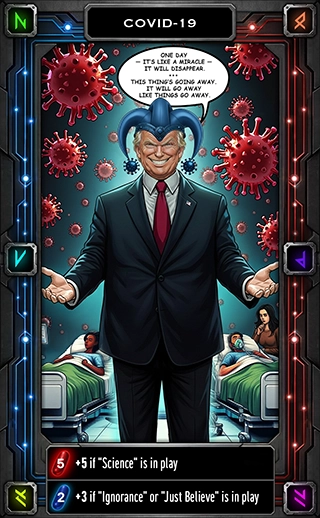
The COVID-19 card sits at the intersection of preparedness structure, executive messaging, and measurable public health outcomes.
Key questions raised by the documented record include:
- How should presidential messaging align with emerging scientific uncertainty?
- What is the impact of structural reorganization on crisis readiness?
- How should responsibility be weighed in a federal system where states hold primary public health authority?
The factual record shows three distinct components: a 2018 structural reorganization, documented public statements minimizing duration expectations, and the quantifiable human toll during and after the first term.
For voters, the issue centers not only on outcomes, but on leadership tone, preparedness prioritization, and crisis communication under uncertainty.
�� Sources
[1] Washington Post; Reuters reporting on 2018 NSC restructuring of the Global Health Security and Biodefense directorate.
[2] PolitiFact and FactCheck.org analyses regarding claims that Trump “fired” the pandemic team.
[3] White House archived transcript, Feb. 27, 2020 meeting with African American leaders.
[4] Fox & Friends interview transcript, Aug. 5, 2020; PolitiFact quote verification.
[5] Johns Hopkins University COVID-19 Dashboard reporting; major outlet coverage (Jan. 2021).
[6] Johns Hopkins University final U.S. cumulative totals (March 2023); retrospective national reporting (2025 five-year mark).
[7] PolitiFact COVID-19 falsehoods roundup; independent fact-check archives (2020).
[8] HHS and federal documentation on Operation Warp Speed and federal COVID response initiatives.