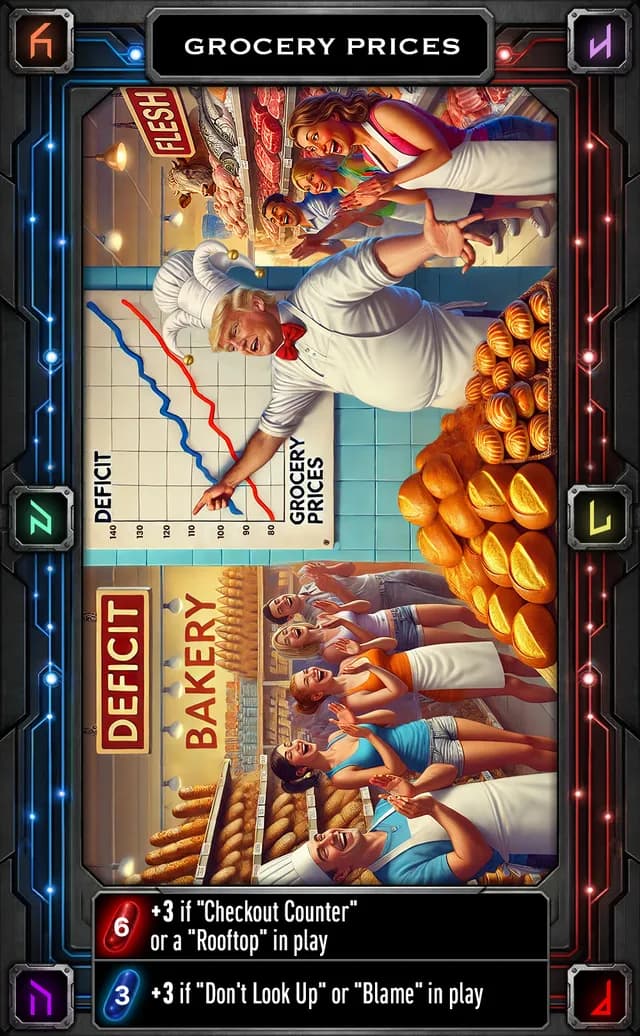
Description:
Donald Trump’s promises to reduce grocery prices versus actual changes in overall food-at-home (grocery) prices during his second term, focusing on broad market outcomes rather than isolated price swings or government-supported interventions.
�� Summary
During the 2024 campaign, Trump repeatedly promised rapid relief from high grocery prices, stating he would “immediately bring prices down” and “make America affordable again.”^[1] After winning, he acknowledged that lowering prices would be “very hard” once they had already risen.^[2]
In practice, overall grocery prices did not fall during his first year back in office. According to Bureau of Labor Statistics data, food-at-home prices increased by about 2.1% from January 2025 to January 2026, and rose 2.4% over calendar year 2025.^[3][4]
While inflation slowed compared to earlier years, the core outcome is clear: on average, groceries remained more expensive, not cheaper, one year into Trump’s second term.
�� Findings
1️⃣ Campaign Promises: Explicit commitments to lower prices
Trump made lowering grocery costs a central campaign message. Reported statements include:
“Starting on Day 1, we will end inflation and make America affordable again.”^[1]
“When I win, I will immediately bring prices down.”^[1]
These statements framed grocery prices as something that could be rapidly reversed through presidential action, not merely stabilized over time.
2️⃣ Post-election shift: Acknowledging limits
After the election, Trump moderated expectations. In a December 2024 Time interview, he said:
“It’s very hard to bring things down once they’re up.”^[2]
This represents a clear shift from certainty (“immediately bring prices down”) to constraint (“very hard”), reflecting the economic reality that price levels are typically “sticky” downward.
3️⃣ What actually happened: Overall grocery prices increased
The most reliable measure is the BLS “food at home” index, which tracks grocery prices broadly.
+2.1%: January 2025 → January 2026^[3]
+2.4%: Calendar year 2025^[4]
This means:
- Grocery prices did not decrease overall
- They continued to rise, albeit more slowly than peak inflation years
This directly contrasts with the campaign framing of immediate price reduction.
4️⃣ Large-category reality: Structural food costs remained elevated
Looking beyond individual items, major grocery categories—especially those tied to inputs like feed, labor, transportation, and energy—continued to reflect elevated price levels rather than reversal.
For example, broad food categories such as meat, poultry, and processed foods are influenced by:
- Livestock cycles and feed costs
- Labor availability
- Fuel and distribution costs
- Long-term supply-chain adjustments
These categories tend to adjust slowly and resist rapid price declines, which helps explain why the overall grocery index continued rising even after general inflation cooled.^[3][4]
�� Pattern Observed
A clear pattern emerges:
- Campaign phase:Simple, high-confidence promises of rapid price reduction
- Governing phase:Acknowledgment that prices are difficult to reverse
- Market outcome:Slower inflation, but no broad price decline
This reflects the difference between inflation (rate of increase) and price level (absolute cost)—a distinction often blurred in political messaging.
�� Discussion
This issue highlights several important economic and psychological dynamics.
1) Level vs. rate confusion
A central misunderstanding is the difference between:
Inflation slowing (prices rising more slowly) vs. Prices falling
Trump’s messaging focused on the second, but the outcome was primarily the first.
2) Irreversibility of price shocks (“ratchet effect”)
Economists often describe price behavior as “sticky downward.” Once prices rise due to:
- supply shocks
- wage increases
- input cost increases
they rarely return fully to previous levels.
Trump’s post-election statement (“very hard”) aligns with this economic reality.^[2]
3) Salience and political messaging
Groceries are one of the most psychologically powerful economic indicators:
- Purchased frequently
- Easily remembered
- Directly felt
This makes them ideal for political messaging—but also prone to oversimplification.
4) Presidential control vs. perception
Presidents influence economic conditions, but they do not directly control grocery prices.
Food prices are driven largely by:
- global commodity markets
- supply chains
- labor costs
- weather and biological factors
- energy prices
This creates a mismatch:
- High political
accountability
- Limited direct control
5) Expectation vs. outcome gap
The strongest takeaway is the gap between:
- Promise: immediate reduction in grocery prices
- Outcome: continued increase (at a slower rate)
This gap is not unusual in economic policy—but groceries make it unusually visible to voters.
�� Sources
[1] ABC News — campaign statements on inflation and grocery prices
[2] ABC News — Trump Time interview (“very hard to bring things down”)
[3] U.S. Bureau of Labor Statistics — CPI (Food at Home), Jan. 2026
[4] U.S. Bureau of Labor Statistics — CPI 2025 Annual Summary
Reference links:
[1] https://abcnews.go.com/Politics/trump-vowed-make-economy-day-1-now-us/story?id=119674028
[2] https://abcnews.go.com/Politics/trump-now-bringing-grocery-prices-promised-hard/story?id=116763207
[3] https://www.bls.gov/news.release/cpi.htm
[4] https://www.bls.gov/opub/ted/2026/consumer-price-index-2025-in-review.htm