Description:
Donald Trump’s handling of classified documents after leaving office; storage at Mar-a-Lago; representations of compliance; subsequent recoveries; public statements; and alleged concealment and sharing.
�� Summary
After leaving office in January 2021, Donald Trump retained government records at Mar-a-Lago. In January 2022, the National Archives retrieved 15 boxes that contained classified material, triggering a Department of Justice (DOJ) referral [1][2]. In May 2022, a grand jury subpoena demanded remaining classified documents. Trump’s attorney certified on June 3, 2022, that a “diligent search” had been conducted and that “any and all” responsive classified materials were returned [3].
On August 8, 2022, the FBI executed a court-authorized search warrant and recovered 102 additional documents with classification markings from Mar-a-Lago — after that certification [4][5].
Subsequent court filings and reporting indicate that additional classified-marked materials were discovered and turned over in November 2022, December 2022, and January 2023, including items found in a storage unit and in Trump’s bedroom [6].
Trump publicly asserted that the government had what it needed and characterized seized materials as “personal papers,” while prosecutors alleged willful retention, concealment, and improper sharing of sensitive information [7][8].
The legal case ultimately centered not only on possession, but on alleged obstruction and misrepresentation.
�� Findings
1️⃣ Initial Retrieval and Escalation (Jan 2022 – June 2022)
January 2022 – 15 Boxes Retrieved
The National Archives and Records Administration (NARA) retrieved 15 boxes from Mar-a-Lago.
NARA later reported that these boxes contained documents marked classified.
NARA referred the matter to DOJ for investigation [1][2].
This referral marked the transition from archival dispute to criminal investigation.
May 2022 Subpoena and June 3 Certification
A federal grand jury subpoena (May 2022) demanded remaining classified documents.
On June 3, 2022, Trump attorney Christina Bobb signed a certification stating a “diligent search” had been conducted and that “any and all” responsive documents were produced [3].
This written certification later became central to obstruction allegations.
2️⃣ August 8, 2022 FBI Search
The FBI executed a court-authorized search warrant at Mar-a-Lago.
102 additional documents with classification markings were recovered [4].
Documents were located in Trump’s office and a storage room [5].
The recovery of 102 classified-marked documents after the June certification raised questions about the completeness and accuracy of the earlier representation.
3️⃣ Additional Classified-Marked Materials Recovered After the Search
Court filings and reporting describe further recoveries:
November 2022: Two classified-marked records found in a West Palm Beach storage unit and turned over [6].
Mid-December 2022: A box containing four additional classified-marked records (reported as Secret level) discovered in a Mar-a-Lago closet [6].
January 2023: Two additional items — an empty folder and a mostly empty folder marked “Classified Evening Summary” — found in Trump’s bedroom and turned over [6].
Key factual pattern: Classified-marked materials were recovered repeatedly after representations of compliance and even after a court-authorized search [3][6].
4️⃣ Public Statements and Framing
Trump made multiple public statements following the August 2022 search:
“They even broke into my safe!” (August 2022) [7]
Claimed agents “grabbed everything in sight.” [7]
Posted that the government could have had what it wanted earlier: “ALL THEY HAD TO DO WAS ASK.” [7]
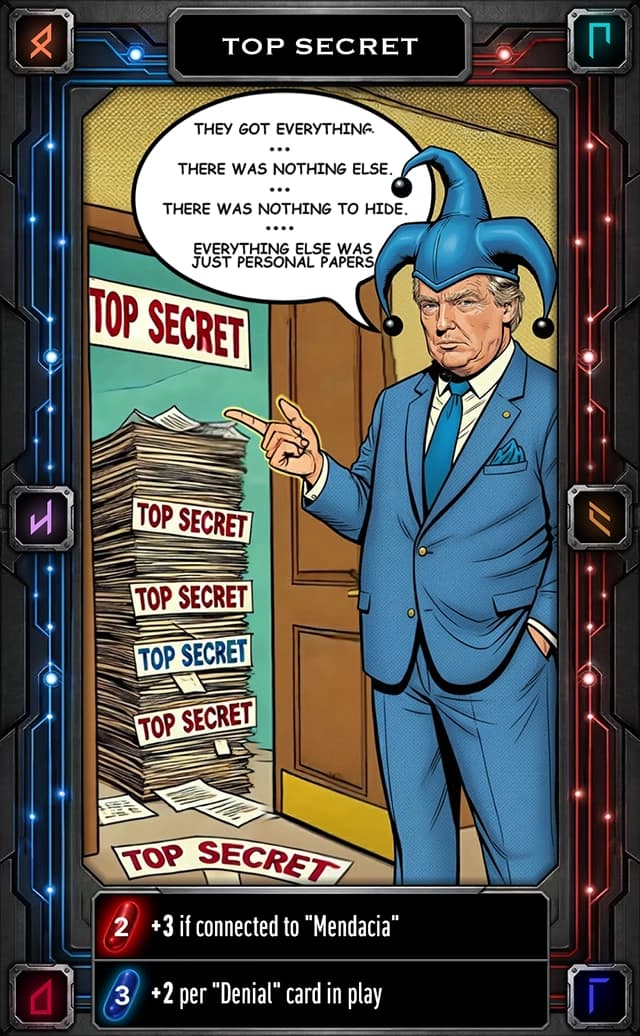
Trump and his representatives frequently characterized seized materials as “personal papers” in public statements and legal filings [8].
These statements framed the search as excessive and politically motivated.
5️⃣ Alleged Concealment and Sharing
Alleged Concealment
The federal indictment alleged:
Trump directed aides to move boxes.
He suggested hiding or withholding documents.
He sought to prevent full compliance with the subpoena [4].
These are allegations contained in charging documents and not adjudicated findings.
Alleged Sharing of Sensitive Information
The indictment also alleged that Trump:
Showed or described sensitive
military information to individuals without clearance (including at Bedminster) [4][5].
These allegations concern oral descriptions and physical display of documents marked classified.
�� Psychological and Rhetorical Dimensions
This case also illustrates several psychological and political framing dynamics:
1️⃣ Minimization and Normalization
Repeated public claims that materials were “personal papers” or that authorities “could have had everything” serve to:
Reduce perceived severity.
Frame the issue as bureaucratic overreach.
Shift focus from retention to process complaints.
This reflects a common defensive communication strategy: redefine the issue as administrative rather than legal.
2️⃣ Victimization Narrative
Statements such as “They broke into my safe” and claims of political targeting frame the search as persecution rather than compliance enforcement.
Research in political psychology shows that victimization framing can:
Strengthen in-group solidarity.
Redirect attention from underlying facts to perceived unfairness.
Activate defensive partisan loyalty.
3️⃣ Obfuscation Through Volume
The large number of documents and procedural steps can create complexity fatigue among the public.
When events involve multiple dates, certifications, and document counts, cognitive overload may reduce clarity, increasing reliance on partisan cues rather than detailed evidence evaluation.
4️⃣ Assertion of Total Compliance
Statements implying “everything was returned” contrast with documented later recoveries [3][6].
Such assertions can:
Create initial impression of full cooperation.
Shift the burden of proof onto investigators.
Increase distrust toward institutions when later contradictions emerge.
�� Pattern Observed
Three patterns stand out:
Initial partial return of documents followed by escalation.
Written certification of compliance contradicted by later recoveries.
Public framing emphasizing persecution, overreach, and personal materials.
The central legal issue evolved from possession to alleged obstruction and misrepresentation.
�� Legal Status Note
The federal classified-documents prosecution was dismissed in 2024 on jurisdictional grounds related to the special counsel’s appointment, and appeals were pending at the time of dismissal [9]. The factual allegations in the indictment were not adjudicated in trial.
�� Sources
[1] National Archives statement on 15 boxes retrieved (Jan 2022). [2] DOJ referral confirmation reporting (2022). [3] June 3, 2022 attorney certification (primary document). [4] Federal indictment, United States v. Trump et al. (2023). [5] ABC News summary of classified document quantities recovered. [6] CBS News reporting on post-search discoveries (Nov–Dec 2022; Jan 2023). [7] Compilation of Trump
Truth Social posts regarding search (Aug 2022). [8] Legal filings referencing “personal papers” characterization. [9] Federal court dismissal order (2024) regarding special counsel authority.