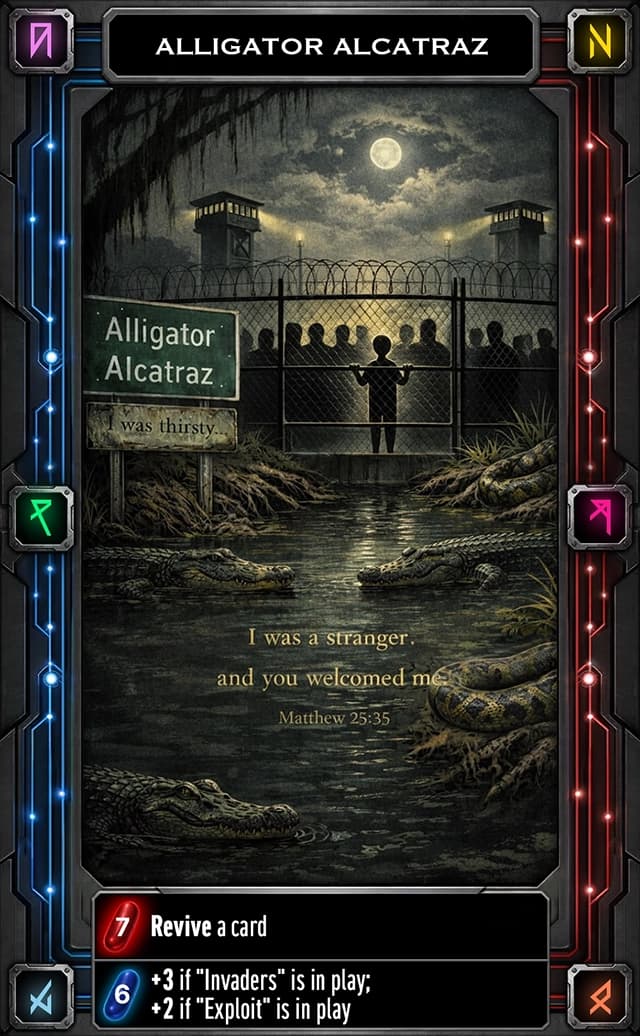
Description:
A symbolic card grounded in Biblical teachings about truth, exposure, and moral
accountability - emphasizing that hidden actions are revealed, individuals are known by their "fruits," and that outward religious identity can be evaluated against observable conduct.
�� Summary
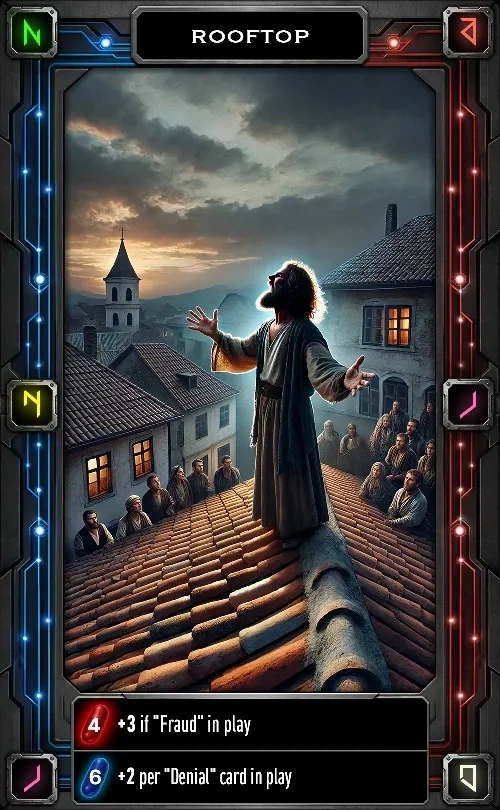
"Rooftop" reflects a central Biblical principle: truth cannot remain hidden. What is done in private - morally, behaviorally, or rhetorically - will eventually be revealed publicly.
This idea connects three core teachings:
- Hidden things are revealed
- People are known by their actions ("fruits")
- Genuine spirituality produces consistent moral traits
In modern context, the card represents a tension between:
- Public religious identity
- Observable behavior and outcomes
�� Findings
1️⃣ "Proclaimed upon the housetops" (Truth becomes public)
Luke 12:2-3 (KJV)
"There is nothing covered, that shall not be revealed...
...shall be proclaimed upon the housetops." [1]
Matthew 10:27 (KJV)
"What ye hear in the ear, that preach ye upon the housetops." [2]
Core meaning:
- Hidden actions -> eventually exposed
- Private behavior -> becomes public knowledge
- Truth -> moves toward visibility over time
Symbolism:
- The rooftop represents maximum exposure
- A place where narrative ends and evidence remains
2️⃣ "By their fruits ye shall know them" (Behavior as evidence)
Matthew 7:16-20 (KJV)
"By their fruits ye shall know them." [3]
Interpretation:
People are evaluated not by:
- Claims
- Identity
- Affiliation
But by:
- Conduct
- Tone
- Moral consistency over time
Key principle:
- Words signal intent
- Actions reveal reality
3️⃣ Fruits of the Spirit (Moral benchmark)
Galatians 5:22-23 (KJV)
These traits function as a benchmark for evaluating character:
- Love - concern for others' well-being
- Joy - inner stability not dependent on domination or conflict
- Peace - avoidance of unnecessary division
- Patience - restraint under pressure
- Kindness - treatment of others with dignity
- Goodness - ethical consistency in action
- Faithfulness - reliability and integrity
- Gentleness - measured use of
power
- Self-control - discipline over impulses
Interpretation:
- These are not symbolic ideals
- They are observable outputs of inner alignment
4️⃣ Religious Symbolism vs. Observable Action
A) St. John's Church Event (June 1, 2020)
Protesters cleared using:
- Chemical irritants
- Crowd-control force [5]
Trump posed with a Bible at St. John's Church [6]
Church leadership response:
- Event described as use of religion as a political symbol
- Not a religious act (no prayer, no service) [7]
Interpretation:
- Religious imagery was publicly displayed
- But the surrounding actions created a contrast between symbol and method
B) 2026: Religious / Messianic Imagery
Reported instances include:
- AI-generated image of Trump being embraced by Jesus [8]
- Imagery portraying him in Christ-like or savior roles [10]
- Prior sharing of imagery depicting himself as the Pope [11]
Reactions:
- Religious leaders and commentators expressed concern or criticism [12]
Interpretation:
- Blurs distinction between political authority and religious or spiritual authority
- Raises question: Is symbolism replacing evaluation of behavior?
5️⃣ Faith Identity vs. Behavioral Evaluation
A central tension:
- Strong support from many Christian groups [9]
- Simultaneous criticism focusing on conduct, tone, and moral consistency with Biblical teachings
Two frameworks emerge:
Supporters emphasize:
- Policy outcomes
- Group alignment
- Instrumental effectiveness
Critics emphasize:
- Ethical consistency
- Personal conduct
- Alignment with Biblical moral standards
�� Pattern Observed
Across both theology and modern behavior:
Biblical framework:
- Truth -> revealed
- Character -> demonstrated through action
- Spirit -> produces consistent traits
Observed modern pattern:
- Identity often outweighs behavior
- Symbolism can substitute for evaluation
- Narratives can delay - but not prevent - exposure
�� Discussion
1) The Rooftop as Accountability
The rooftop represents:
- Exposure of hidden reality
- Collapse of controlled narratives
- Evaluation based on evidence rather than claims
2) Symbol vs Substance
Religious symbolism can:
- Signal alignment
- Strengthen group identity
But Biblical teaching prioritizes:
- Substance (fruit) over appearance (symbol)
3) Why the Tension Persists (Psychological Layer)
Several mechanisms help explain continued support despite contradictions:
- Identity protection -> Loyalty to group overrides evaluation
- Motivated reasoning -> Evidence filtered to preserve beliefs
- Moral tradeoffs -> Outcomes prioritized over conduct
- Symbolic substitution -> Imagery replaces behavioral assessment
4) Core Biblical Standard
The combined teachings suggest:
- Truth will be revealed
- Character will be visible
- Claims will be tested against outcomes
Evaluation is not based on:
- What is said
- What is displayed
But on:
- What is consistently done
5) Core Insight
The "Rooftop" principle ultimately asserts:
What is hidden becomes visible,
and what is claimed is measured by what is produced.
�� Sources
[1] Luke 12:2-3 (KJV)
[2] Matthew 10:27 (KJV)
[3] Matthew 7:16-20 (KJV)
[4] Galatians 5:22-23 (KJV)
[5] U.S. Park Police / Inspector General report (Lafayette Square clearing)
[6] AP / PBS / NBC coverage of St. John's Church event
[7] Episcopal Diocese of Washington statements
[8] ABC News - Trump shares AI image with Jesus
[9] Pew Research Center - evangelical voting patterns
[10] Spectrum News - Christ-like imagery reporting
[11] Reporting on Trump sharing Pope imagery
[12] Le Monde - religious backlash coverage